Welcome to the Understanding Javascript basics series. On this blog we will try to understand primitive types in Javascript.
let's get to it 🙂
01Primitive and non-primitive types
Javascript has primitive types (primitive values) that are directly represented at the lowest level of the language implementation. Javascript in general has two types of data types - primitive and non-primitive (Object). Anything other than primitive types in JavaScript is an object. Functions, classes, arrays and user defined types are all objects.
Checking with typeof
You can tell this by using the typeof operator which might not be accurate at a time but it's a good enough approximation.
1typeof 'hello' // string2typeof true // boolean3typeof 1 // number4typeof {} // object5typeof null // object6typeof undefined // undefined7typeof function () {} // function8typeof Symbol('hello') // symbol1typeof 'hello' // string2typeof true // boolean3typeof 1 // number4typeof {} // object5typeof null // object6typeof undefined // undefined7typeof function () {} // function8typeof Symbol('hello') // symbol
The typeof null quirk
But here typeof null is an object which is not actually true since null is a primitive type.
typeof null // objecttypeof null // object
This is considered a bug in javascript.
02Primitive values are immutable
Javascript primitive types are not objects and their values are immutable. but variables can be reassigned to a new value. Doing so will create a new variable and the garbage collector will clean up the old one.
example of primitive type immutability
1let a = 1;2let b = a;3// changing a will not change b4a = 2;5console.log(a); // 26console.log(b); // 11let a = 1;2let b = a;3// changing a will not change b4a = 2;5console.log(a); // 26console.log(b); // 1
As both a and b are primitive types, they are not related to each other.
when copying b from a Javascript will copy the value of a and assign it to b , so changing one will not change the other.
03What happens in memory
Let's dive deep into this
Creating a value
let a = 1;
let a = 1;
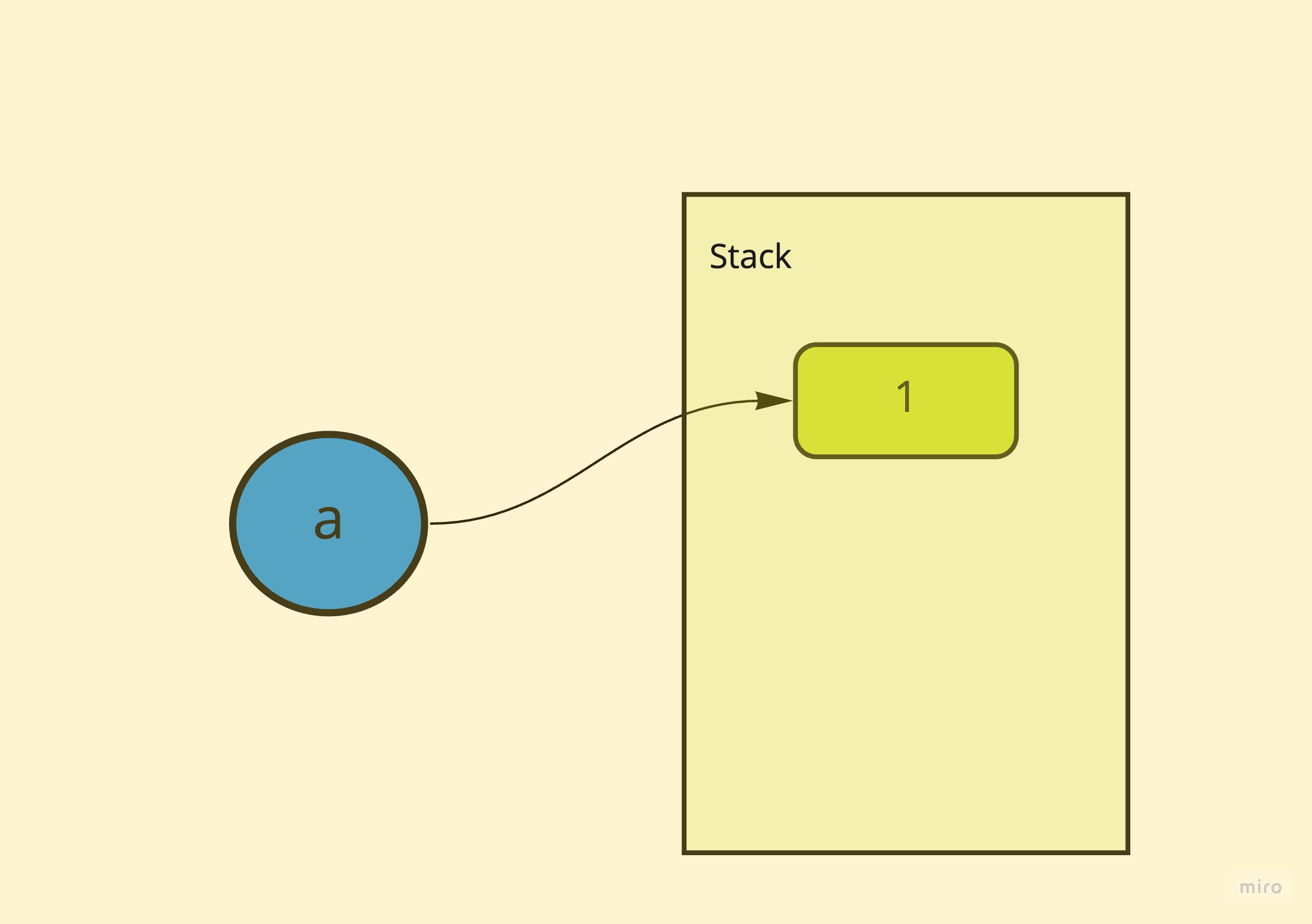
Initializing a variable with a primitive type will create a new value in stack and assign the variable to it. JavaScript creates primitive types in stack with fixed space while Objects are created in heap memory, This is because objects are mutable and can be changed at any time taking up more memory. This is true because you can mutate objects adding new properties or changing existing ones.
Copying a value
let a = 1;let b = a;
let a = 1;let b = a;
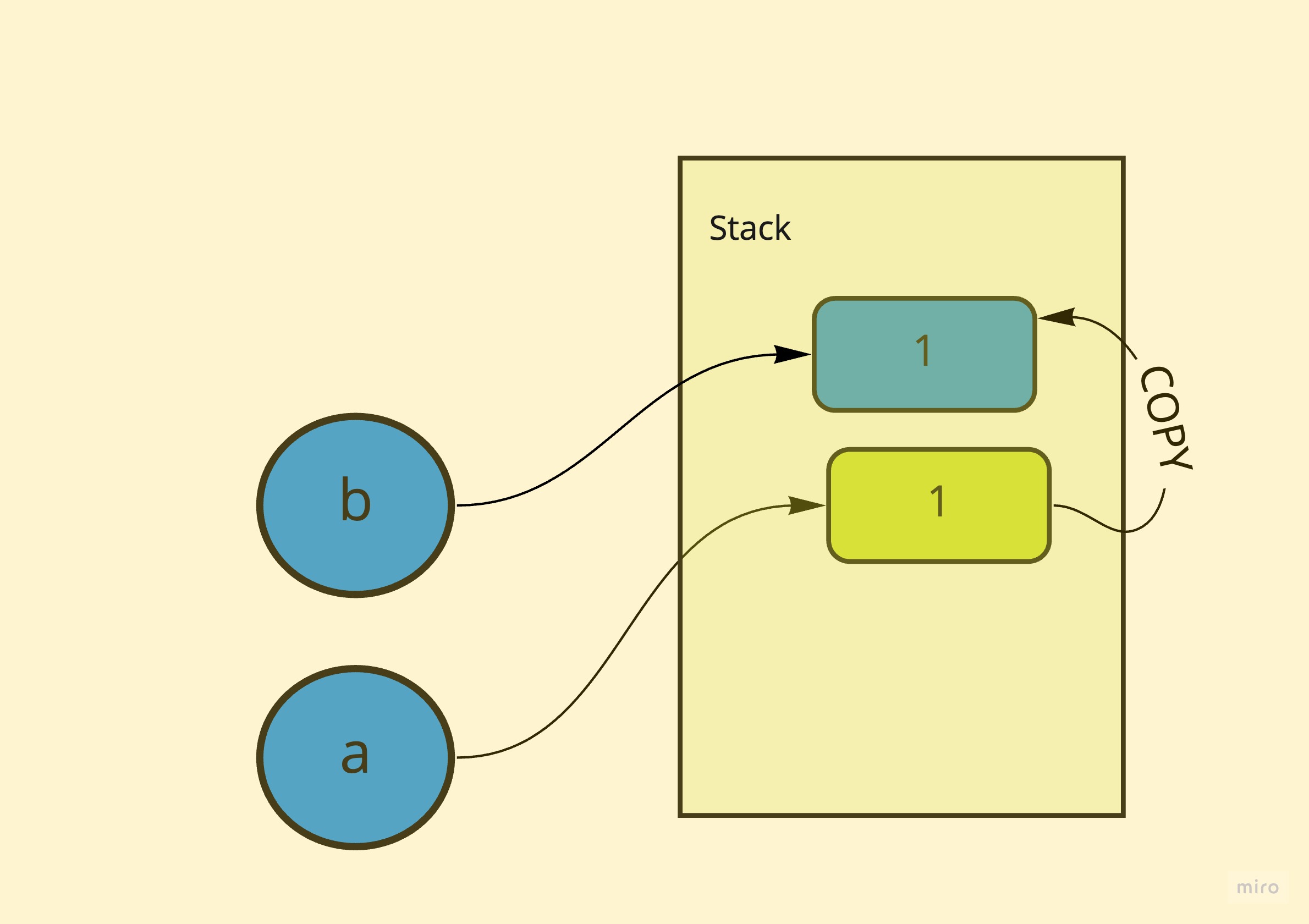
Copying a primitive type will create a new value in stack and assign the variable to it.At this point both a and b are pointing to different values in the stack.
Reassigning a value
1let a = 1;2let b = a;3a = 2;
1let a = 1;2let b = a;3a = 2;
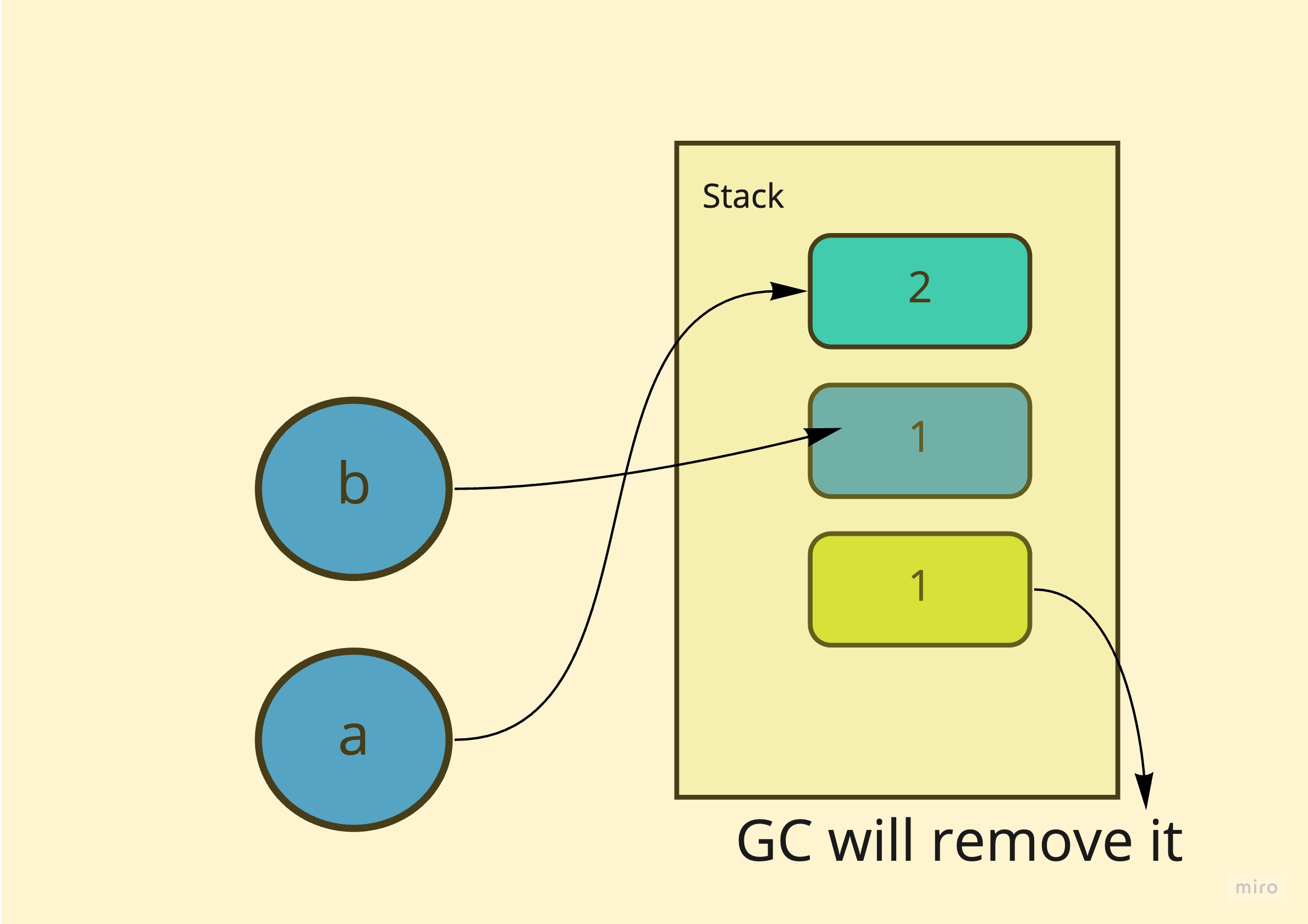
Changing the value of a will not change the value of b since they are pointing to different address in the stack.At this point GC( Garbage Collector) will remove unreferenced addresses from the stack.
04Primitives and objects compared
Comparing primitive types to object 👇🏾
1let a = {2 value: 13};4let b = a;5// changing a will change b as they have the same reference6a.value = 2;7console.log(a.value); // 28console.log(b.value); // 21let a = {2 value: 13};4let b = a;5// changing a will change b as they have the same reference6a.value = 2;7console.log(a.value); // 28console.log(b.value); // 2
As you can see in the above example, Objects variables don't hold values but references, so changing a will change b as they have the same reference.
05How primitives act like objects
Well if primitives are not Objects you might ask how are we accessing properties off them like this example below ?
'hello'.length // 5'hello'.length // 5

This is not a bug in javascript 😄.
Wrapper objects
This is actually one of the features of javascript. Primitives are not Objects but they act like they are 🤔 ? Well here is how it works
Javascript maps out primitive types to Wrapper Objects which is the reason we can see the length property of a string.
Which will actually create a new object with value "hello", so you can access the length property ( or any-other String property ) off that object. This is actually true for Other two Primitive types Boolean and Number .
1let strObj = new String('hello')2typeof strObj // object3strObj.length // 545// access the value of the object , which is the primitive value6strObj.valueOf() // hello7typeof strObj.valueOf() // string1let strObj = new String('hello')2typeof strObj // object3strObj.length // 545// access the value of the object , which is the primitive value6strObj.valueOf() // hello7typeof strObj.valueOf() // string
Boolean and Number wrappers
Boolean Object
1let boolObj = new Boolean(true)2typeof boolObj // object3boolObj.valueOf() // true4typeof boolObj.valueOf() // boolean1let boolObj = new Boolean(true)2typeof boolObj // object3boolObj.valueOf() // true4typeof boolObj.valueOf() // boolean
Number Object
1let numObj = new Number(1)2typeof numObj // object3numObj.toFixed(2) // 1.0045numObj.valueOf() // 16typeof numObj.valueOf() // number1let numObj = new Number(1)2typeof numObj // object3numObj.toFixed(2) // 1.0045numObj.valueOf() // 16typeof numObj.valueOf() // number
But once we had access to the property of the object, garbage Collector will remove unused objects from memory.
06The seven primitive types
Javascript has 7 primitive types:
- undefined
- null
- boolean
- number
- string
- symbol - es2015
- bigint - es2020
The symbol data type is new in es6.
bigint is new in es2020.
How JavaScript differs from Java
JavaScript is different in the way it treats Numbers and Strings ( they are represented as a primitive type on their own) which is not as common in stablished programming languages like Java, Which for example represent numbers differently according to their size and properties. Float numbers have a float type in Java and integers as int while in javascript they are both just represent as Number.
07What's next
We will dive deeper into those primitive types and javascript implementation difference with other programming languages in the next blog of this series.
Big thanks for the people whom helped me review the wording in this blog.